
DevSecOps, part 5 of 9
Threat Modeling
Threat ModelingDevSecOps
Summary
This guide explains what a threat model is and how to identify common threats in cloud and DevOps infrastructure environments. It is based on frameworks such as OWASP Top 10 for web/infrastructure applications and MITRE ATT&CK for adversary tactics.
Prerequisites
- Basic knowledge of cybersecurity (vulnerabilities, common attacks).
- Understanding of cloud environments (AWS, Azure, GCP) or on-premises infrastructure (Kubernetes, Docker).
What Is a Threat Model?
A threat model is a structured process for identifying, quantifying and prioritizing potential threats to a system. It helps you understand what can go wrong and how to mitigate it before it happens.
Key Components
- Assets: What to protect (data, services, infrastructure).
- Threats: What can harm the assets (hackers, malware, human error).
- Vulnerabilities: Weaknesses that enable threats.
- Mitigations: Controls to reduce risks.
Common Threats in Infrastructure
OWASP Top 10 for Infrastructure
- Broken Access Control: Unauthorized access to resources.
- Cryptographic Failures: Weak or misconfigured encryption.
- Injection: Attacks such as SQL injection in APIs or configs.
- Insecure Design: Architectures with inherent security flaws.
- Security Misconfiguration: Default or exposed configurations.
- Vulnerable Components: Dependencies with known CVEs.
- Identification and Authentication Failures: Weak authentication.
- Software and Data Integrity Failures: Manipulation of data or software.
- Security Logging and Monitoring Failures: Missing logs for detection.
- Server-Side Request Forgery (SSRF): Attacks launched from the server.
MITRE ATT&CK for Infrastructure
Common tactics in cloud/K8s environments:
- Reconnaissance: Port scanning, service enumeration.
- Initial Access: Exploitation of exposed configs (e.g., public S3 buckets).
- Execution: Remote code execution in containers.
- Persistence: Backdoors in Docker images or K8s configs.
- Privilege Escalation: From user to root in pods.
- Defense Evasion: Hiding malware in ephemeral containers.
How to Create a Threat Model
Steps
- Define scope: Diagram the architecture (use draw.io or Mermaid).
- Identify assets: Sensitive data, APIs, databases.
- Enumerate threats: Use STRIDE (Spoofing, Tampering, Repudiation, Information Disclosure, Denial of Service, Elevation of Privilege).
- Assess risks: Probability vs impact.
- Define mitigations: Technical controls and processes.
Tools
- Microsoft Threat Modeling Tool: Free, guided.
- OWASP Threat Dragon: Open source, web-based.
- Mermaid for diagrams: Built into this documentation.
Examples
Simple threat diagram in K8s
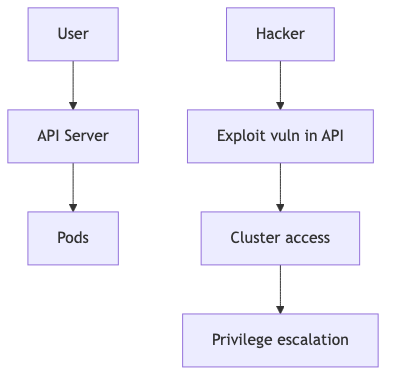
Mitigations: strict RBAC, Network Policies, admission controllers.