DevSecOps, part 7 of 9
Secrets Management
Secrets ManagementDevSecOps
Overview
This guide compares secrets management options in DevOps: HashiCorp Vault, AWS Secrets Manager, and Kubernetes Secrets. It explains when to use each and the main best practices.
Prerequisites
- Basic Kubernetes and cloud (AWS/Azure/GCP) knowledge.
- Understanding of encryption and authentication fundamentals.
Main Solutions
HashiCorp Vault
Vault is an open-source, central secrets manager with encryption, auditing, and automatic rotation.
Features
- Secret engines: KV, databases, cloud providers.
- Auth methods: LDAP, JWT, certificates, cloud IAM.
- Encryption: In transit and at rest with rotating keys.
- Auditing: Detailed access logs.
Installation
helm repo add hashicorp https://helm.releases.hashicorp.com
helm install vault hashicorp/vault

wget https://releases.hashicorp.com/vault/1.15.0/vault_1.15.0_linux_amd64.zip
unzip vault_*.zip
sudo mv vault /usr/local/bin/
Basic Usage
vault server -dev
vault kv put secret/myapp db_password="supersecret"
vault kv get secret/myapp
K8s Integration
apiVersion: secrets.hashicorp.com/v1beta1
kind: VaultStaticSecret
metadata:
  name: my-secret
spec:
  vaultAuthRef: vault-auth
  mount: secret
  path: myapp
  destination:
    create: true
    name: my-secret
AWS Secrets Manager
Managed AWS service for storing and rotating secrets.
Features
- Native integration: Lambda, RDS, ECS.
- Automatic rotation: Databases and credentials.
- Encryption: Backed by KMS.
- Access: IAM policies.
Usage
aws secretsmanager create-secret --name my-secret --secret-string '{"username":"admin","password":"secret"}'import boto3
client = boto3.client('secretsmanager')
secret = client.get_secret_value(SecretId='my-secret')Kubernetes Secrets
Native K8s resource for sensitive data.
Types
- Opaque: Arbitrary data.
- TLS: Certificates.
- Docker-registry: Registry credentials.
Limitations
- Not encrypted at rest in etcd by default.
- Access via RBAC, but limited auditing.
- Best for low-sensitivity data or when paired with external managers.
Example
apiVersion: v1
kind: Secret
metadata:
  name: my-secret
type: Opaque
data:
  username: YWRtaW4=
  password: c2VjcmV0
Comparison
| Aspect | Vault | AWS Secrets Manager | K8s Secrets |
|---|---|---|---|
| Cost | Free (open source) | Pay-per-use | Free |
| Scalability | High | High | Medium |
| Cloud integration | Good | Excellent (AWS) | Good |
| Auditing | Advanced | Basic | Limited |
| Complexity | High | Low | Medium |
Best Practices
- Least privilege: Scope access tightly.
- Rotation: Automate secret rotation.
- Monitoring: Alert on unusual access.
- Backup: Have a recovery plan.
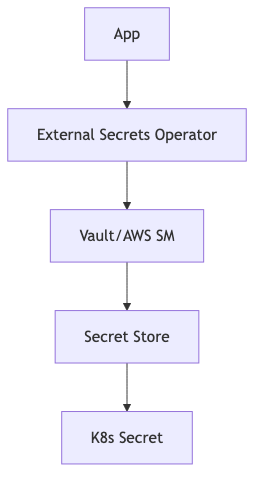
- Avoid Git: Never commit secrets; use External Secrets Operator or similar.
Architecture Example (External Secrets)